A Kansas City family shopping for competitive youth soccer today will find published annual club fees running from $1,508 to $4,700 for ages U9 and up, depending on the club and the program. That is the spread for club fees alone. Required uniforms, team fees, and travel usually sit on top, and at most clubs some of those costs are not published anywhere.
And that spread only covers the clubs where a price can be found at all. At three organizations in this Index, a family cannot learn the cost of playing from the club's public pages, each for a different reason, and the reasons matter.
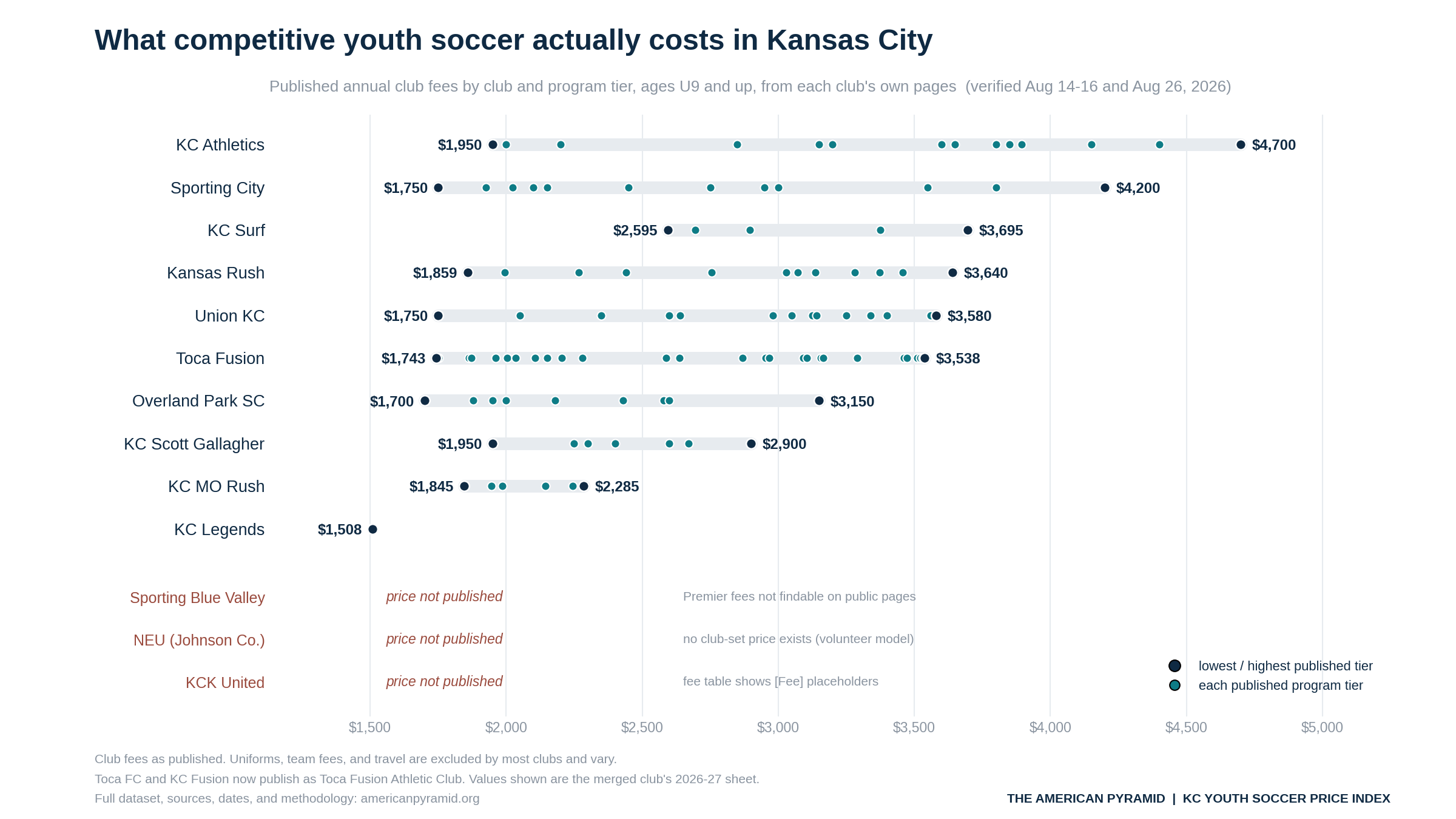
The Index is a side-by-side record of published prices at the Kansas City metro's competitive youth soccer clubs, covering Johnson County, Kansas City Missouri, Wyandotte County, and the Northland. Thirteen organizations, spanning fourteen legacy club identities, currently carry values or documented classifications, built from nearly two hundred sourced rows. Every figure was collected from the club's own published page, carries its source URL and collection date, was re-verified in a live browser in the three days before publication, August 14 to 16, 2026, or on the date shown in its correction note, and is archived at the Internet Archive so the citation outlives any website change. The full dataset and the complete methodology are public.
This is not a ranking. Expensive is not an accusation and cheap is not an award. The Index measures what a family can learn before committing, which is the number that decides whether they ever walk in the door.
The price of the same sport varies by more than three to one
The lowest published competitive club fee in the dataset is $1,508, at a club that publishes every component of its price and whose own front office reviewed and confirmed its listing before publication. The highest is $4,700 before uniforms. Both are real prices at real Kansas City clubs for youth soccer. The difference across the metro is not primarily about field time. It tracks platform membership, league affiliation, travel footprint, and what each club chooses to bundle into its number.
At three clubs, there is no number to find
- Sporting Blue Valley publishes prices for its recreational and entry programs, but its premier competitive fees are not findable on its public pages. Its premier pages describe travel expenses, financial aid, high school eligibility, and team fees, everything about the money except an amount. The check was performed on a desktop browser on August 15.
- Northeast United has no club-set price for competitive play. It still runs a legacy volunteer model where teams collect league fees the old way, with paper forms; for ages U9 and up, its published fees are per-team league pass-throughs, so what a family pays depends on how a team splits them. (Refined September 14, 2026: coach packets linked from the club's homepage publish two flat per-player fees for its youngest recreational ages, recorded in the dataset as entry-tier rows.) This is not opacity. It is a club operating in an earlier era of the sport, and it doubles as the metro's clearest example of how hard a small club can be to find at all: an ordinary search for the club's name surfaces same-name organizations in Connecticut, Calgary, and Minnesota, and a professional team in India, before anything belonging to the local club.
- KCK United, Wyandotte County's club, published a fee table whose amounts read "[Fee]" in every age band when collected, and still did on August 14. Its tryouts page lists everything the fee includes, practices, games, uniform, team meals, and community service, without stating the fee, and offers sponsorships so no player is turned away. The site was rebuilt this spring around a sponsorship-first model, and the empty table reads as an unfinished build rather than concealment. Wyandotte's real finding is structural: in a county where a 2015 report counted one boys' and one girls' club, the Index in 2026 still finds a single club-level organization.
How clubs publish is a finding in itself
Collection surfaced seven distinct delivery patterns, from clubs that publish one all-in number with a printed inclusion list, to clubs whose full price exists only as arithmetic across three pages, to complete fee schedules published as images that no search engine or screen reader can read, to precise base fees sitting on top of team-fee layers that are real, mandatory, and unbounded on paper. The methodology page defines every pattern. Several deserve naming here because they are positive: Union KC publishes genuinely all-in numbers with printed inclusion lists on every one of its seven platform pages. Toca Fusion publishes all-in sheets that name uniforms and travel as the only things not included. KC MO Rush goes a step further than any club in the dataset on content: its published price includes its team fees and coaches fees, the layer that at other clubs is estimated, changeable, and open-ended. KC Legends publishes every component a family needs to compute its total. And KC Scott Gallagher pairs every published price with an explicit list of what is not included, down to naming its team-level and travel costs. Transparency is achievable at every price point, because clubs at several price points already achieve it.
The details families actually trip over
- Uniforms are required everywhere and inside the published price almost nowhere. Across nearly two hundred rows, a required uniform package appears inside the published fee at exactly one current offering, and at that offering the word "Uniforms" is printed on the page in white text a reader cannot see without highlighting it. Everywhere else uniforms are a separate cost, published or not, running $167 to $320 where a price exists at all.
- High school pricing follows a hidden rule, and one club prints the rule on its page. At most clubs measured, high school programs price below the U13 to U14 peak because clubs run fewer sessions around the school season. One club states the reason outright: "High school age players will pay less due to participation with their high schools." But the rule is platform-dependent. KC Surf's elite platforms discount high school by one training season while its standard tier charges high schoolers the U13 to U14 price, and Union KC's national-platform teams invert the rule entirely, charging high schoolers more. Families comparing clubs by a single age band are often comparing different amounts of soccer.
- Age does not always price the way families assume. At two clubs, a younger band prices above an older one at the same tier, in one case tracking the number of weekly field nights, in the other putting the U15 to U17 band above both the U19s and the U13 to U14 peak.
- Season labels are the quietest risk. In August, with fall invoices going out, one club's program pages carry no season label at all, on any of its seven platform pages. A family on those pages cannot tell whether the price on the screen is this year's. Other label questions in the metro trace to a single cause, described next.
- Girls sometimes pay more, sometimes less, and sometimes exactly the same. At the metro's highest-priced club, the girls' top-platform fee runs $550 above the boys' equivalent at the same tier, a gap consistent with the different league platforms each side plays on. Inside the metro's newest merged club, the gap runs both ways: in the same program, boys pay more than girls at one age band and girls pay more than boys at the next. And KC Surf prices all nineteen of its published programs identically for boys and girls. The Index reports the measurements and the league context and editorializes no further.
The metro's newest merger
Toca FC and KC Fusion are coming together as Toca Fusion Athletic Club, per the clubs' own pages. As of August 15, 2026, that transition means three live cost pages exist for one club family: the legacy Toca FC site still carries complete 2025-26 fee sheets, the legacy KC Fusion pricing page still carries 2025-26 season labels, and the merged club's new site publishes full 2026-27 pricing for boys and girls. All three are archived with dates. This Index publishes the merged club's current 2026-27 values, and reports the rest because it is the clearest live example of a problem families face everywhere: the answer you get depends on which version of a club's web presence you happen to find.
What the Index cannot see
The published price is not always the paid price. Scholarships, sibling discounts, payment plans, and team-level costs move real families' totals in both directions, and none of that is visible from public pages. The Index measures the information available to a family before they commit. By that measure, this metro asks many of its families to commit first and learn the price later.
The first re-verification, September 2026
Between September 11 and September 14, 2026, every volatile listing in the Index was re-checked in a live browser under the same rules as the original collection: a full navigation audit per club, published figures only, every figure carrying a source URL and a collection date, and every source archived. This is the update cycle promised in the August 26 correction.
The headline: no published competitive club fee in the metro moved. The $1,508 floor and the $4,700 ceiling both held, every season label read as it did in August, and the three organizations where a family could not find a competitive price at publication still publish none. At Sporting Blue Valley, the pass also walked the club's separate registration hub, which describes the fee structure, deposit terms included, without stating an amount, and its registration pages, which require an account before showing a fee. The no-findable-price finding stands on more evidence than it did in August.
The pass added three prices to the dataset, all from entry programs for the metro's youngest players, all below age U9, and all outside the competitive range this Index headlines. Northeast United publishes flat per-player recreational fees of $55 and $65 in coach packets linked from its homepage, and KC Scott Gallagher publishes a $750 pre-competitive program. They are recorded as entry-tier rows so that a kindergartner's rec fee is never mistaken for a competitive club fee, and Finding 02 is refined to match: for competitive play, Northeast United sets no player price at all, publishing only per-team league fees that families split.
One page change was observed since publication. KC Scott Gallagher's tryouts page now publishes an email contact, where the Index recorded no published contact channel at launch; the listing is updated as of September 14. The Index records pages as they stand and claims no credit for what changes on them.
One correction from the pass is logged in the corrections section below. This update also adds a population appendix further down the page: the counties the Index covers, how many children live in each, and where the metro's club-level organizations are based, with every population figure carrying its Census Bureau table and vintage.
Corrections, openly
Every club with rows in this Index was sent its own rows, with sources, before publication through the club's published contact channel, and every club was invited to correct them. One club published no contact channel at all on its public site when those notes went out, and that fact is recorded in its listing; as of September 14, 2026, its tryouts page publishes an email contact, and the listing is updated. The correction invitation applies to that club as fully as to every other. The invitation is permanent: jon@americanpyramid.org. Verified corrections will be made and logged openly with a note. During collection and verification, one classification was upgraded when better evidence replaced an outdated source, one compressed value was split when the club's own document showed two tiers, and two clubs' superseded price sets were replaced by their current published sheets with the full trail preserved, because an index that asks clubs for transparency owes them the same. The first club to respond reviewed its rows and confirmed them unchanged.
Correction, August 26, 2026. A reader pointed out that Sporting City's listing looked too low. They were right, and the error was ours. Our collection followed the club's three regional program pages and never walked its separate competitive navigation, so the Index missed eight published tiers: MLS NEXT Homegrown and Academy, Girls Academy, National Academy League, and Pre-MLS NEXT. All eight publish 2026-27 fees on the club's own pages, with inclusion lists. Sporting City's published range is therefore $1,750 to $4,200, not $1,750 to $2,150, and the club moves from ninth to second on the chart. The metro range and the ratio in finding one are unchanged. The new rows are dated August 26 in the dataset. To be clear about where the fault sits: these programs are listed plainly in the club's own competitive menu, so this was our collection error and not a case of a club hiding anything. A full navigation audit of every club is now part of the Index's monthly update cycle. And the standing commitment holds: any verifiable published fee that adds to or contradicts a listing, whether it comes from a club, a parent, or anyone else, gets checked and corrected promptly.
Correction, September 14, 2026. Update #1's re-verification found that the KC Legends Jr Legends listing, an entry program for birth years 2018 to 2020, below the ages this Index headlines, carried a stale $175: the club restructured that program's published pricing in mid-August, after collection, and our verification pass missed it. The row now records the current published components, collected September 14. The U9-and-up range, the chart, and the $1,508 floor are unaffected.
The metro the Index measures
The Kansas City metro area is home to 2,218,142 people, 391,711 of them children aged 5 to 17 (U.S. Census Bureau, American Community Survey 2024 five-year estimates, table S0101). The Index's coverage area is the seven counties below, which hold 2,070,650 of those people and 365,688 of those children. This appendix is context, not measurement: the Index measures published prices, and this table records how many families each finding touches, and where the organizations that set those prices actually sit.
| County | Population | Children 5 to 17 | Organizations based there | Publish a findable competitive price |
|---|---|---|---|---|
| Jackson, MO | 719,976 | 123,471 | 0 | |
| Johnson, KS | 620,631 | 109,480 | 9 | 7 of 9 |
| Clay, MO | 258,122 | 45,406 | 2 | 2 of 2 |
| Wyandotte, KS | 167,654 | 33,758 | 1 | 0 of 1 |
| Cass, MO | 110,773 | 19,741 | 0 | |
| Platte, MO | 110,371 | 19,192 | 0 | |
| Leavenworth, KS | 83,123 | 14,640 | 0 | |
| Coverage total | 2,070,650 | 365,688 | 12 | 9 of 12 |
Attribution by organization: Johnson County holds Toca Fusion, Sporting Blue Valley, KC Legends, Kansas Rush, KC Athletics, Kansas City Surf, Overland Park SC, Union KC, and Northeast United; Clay County holds KC MO Rush and KC Scott Gallagher; Wyandotte County holds KCK United. Sporting City, the one organization in the Index that is multi-county by its own pages, operates across Johnson, Wyandotte, Platte, and Jackson counties, publishes a price for every program, and is counted in no single county row; with it, the Index's thirteen organizations. KC Scott Gallagher publishes its location on its Facebook page rather than its website.
No organization in the Index is based in Jackson County, home to 123,471 children aged 5 to 17, more than any other county in the metro. Two organizations publish facilities there: Sporting City's East region plays at Swope Soccer Village and the Barstow School, and Kansas City Surf lists University Academy among its facilities. Nine of the thirteen organizations are based in Johnson County. Where a metro's clubs sit is not where all of its children live, and this table is the plainest way the Index can show it.
Wyandotte County remains the sharpest story the Index tells. In 2015, KCUR documented one boys' club and one girls' club in the county. In 2026, the Index finds a single club-level organization based there, its fee table publishing no amounts, in a county of 33,758 children aged 5 to 17.
Population figures are from the American Community Survey 2024 five-year estimates, table S0101, retrieved and verified at data.census.gov on September 13, 2026; children 5 to 17 sums the published 5-to-14 and 15-to-17 rows and was cross-checked per county against under-18 minus under-5. County attribution for each organization follows the location published on the organization's own pages, its website first and its own public profile where the website publishes none, and each source is archived.
The plan behind the measurement
The World Cup came to Kansas City and it was amazing. The American Pyramid is the published plan to make it last, and a plan to end pay-to-play has to start by measuring what pay-to-play actually costs, in public, with sources. This page is that measurement for one metro. It gets re-verified, corrected, and updated as clubs change their pages, and it will get better every time a club decides its price belongs in the open.